1929—the Great Depression in Albany County
Now
President-elect Herbert Hoover took office in March 1929, never imagining that a stock market crash seven months later would become a decade-long depression affecting everyone.
Looking back on it, the great question about the Great Depression is “Why didn’t the people revolt?” Politicians didn’t dare bring up the Bolshevik Revolution just 12 years earlier when communists came to power in Russia. But US politicians were thinking of just that, as Chicago journalist Studs Terkel reported in his 1970 book “Hard Times.” It included oral histories he conducted with some of them. Stanford historian David M. Kennedy wrote that Franklin D. Roosevelt (FDR) was puzzled by the peaceful approach Americans took to hard times.
Hoover’s one term in office was during the worst part of the Great Depression in Albany County. Estimates now suggest that 1 out of every 4 breadwinners was out of work nationwide, and it was probably about the same here. At that time there were no Wyoming social services or health departments to support the needy—county commissioners were expected to care for impoverished people if their families could not. On April 23, 1931, the Laramie Republican/Boomerang published Albany County’s monthly expenditures for orphan and elderly care—a total of $2,135. That amount was a pittance, compared to what would soon be needed when many local families had an out-of-work parent with no savings, and possibly no home.
In Albany County the oil refinery, tie plant, Railway Express, stockyards, and other businesses closed or laid off employees. Railroader Edward Small recalls that there had been 85 trains per day going through Laramie, but in the “bottom of the depression” there were 20 westbound and 15 eastbound each day. Livestock shipping essentially ended; fewer crews like Small’s were needed—the Union Pacific Railroad laid off thousands.
Transients arrive
Residents probably first noticed the influx of transients in 1930. Many hitched illegal train rides, joining the hobos who had a long history of evading railroad detectives. But this time the riders included women and children, as observed by locals living near the tracks. Potter’s Field of Greenhill Cemetery includes 25 graves of men with no identification who may have lost lives trying to hop on or off the moving trains in the Laramie railyard during the depression; burial dates were not recorded.
On April 22, 1931, the newspaper reported that all City Hall jail cells were full of transients. Some had to sleep on benches in police headquarters, as the 1872 county courthouse cells were unavailable—the building was about to be torn down. The police did not feed the transients they turned out in the morning.
The hungry were generally given food when they came to back doors of Laramie homes. John Surline recalled that strangers came to his grandparent’s home at 756 5th St., seeming to know that food could be had there. Widow Eliza Smart Glenn lost her job and moved in with her father when the Kuster Hotel closed, but according to her daughter she became well-known for home-cooked meals served to anyone who came to her father’s home at 614 S. 7th St.
The Salvation Army and the Red Cross developed food programs that relied on cash and canned goods donated by the community. The University of Wyoming (UW) held food drives for married student families. The Veterans of Foreign Wars and others assisted with Laramie soup kitchens, one may have been at 214 Fremont St., where the Salvation Army was headquartered. Teenage volunteer server Lottie Pingetzer turned up her nose at the food quality in the soup kitchens, but hungry folks were unlikely to be fussy.
Dustbowl
The dustbowl of the 1930s was concurrent with the Great Depression. Although Albany County was on the northwest fringe of this environmental tragedy centered around the Texas and Oklahoma panhandles, its effect was felt even here on occasion. UW faculty wife Cecil Nussbaum wrote about putting wet towels around windows and doors to keep the dust out. Those affected in the heart of the dustbowl piled everything they could into the family vehicle and headed anywhere work might be found. Most traveled west, but others came north to Wyoming and Montana. Oklahoma natives Elmo and Jess Hubbard came through Laramie in 1935. Their gas money ran out 20 miles north. T.L. Eaton, owner of the Bosler gas station, let the brothers and their families stay free in one of his cabins.
The two men started jobs surfacing the road between Bosler and Wheatland but were let go when the foreman said the jobs were only for local men. Jess owned the car and moved his family to Montana. But Elmo, his wife Ruby and their daughter stayed in the Bosler cabin for four years, and another daughter was born there. Elmo was trained as a mechanic, so Eaton hired him to run the Bosler Texaco station. As the depression eased, Elmo and Ruby found jobs at UW; eventually they bought a house in Laramie and made it their permanent home; their family grew to four daughters.
Married women
In 1932 Hoover signed the Economy Act, preventing more than one family member from working for the Federal Government. The one with the lowest salary, often the wife, had to resign. Another law required a married woman to take her husband’s name so she was easier to track. Many state and local governments as well as private companies followed suit. As a jobs-creation measure, many married women were terminated, regardless of where their husbands worked. Local school districts and colleges across the country released married women, as happened to UW’s Helen Dunnewald and Jackie Crawford. Verna Johanneson resigned from UW when she was about to marry Laramie architect Wilbur Hitchcock.
Single women generally supported this measure, but instead of creating more jobs for men and single women, it actually eliminated jobs.
New Deal ABCs
FDR was governor of New York State when the Great Depression began in 1929. He responded by designing new programs to provide jobs and assistance to suffering New Yorkers. As president-elect, he promised to put about 20 of these “New Deal” policies into practice in the first 100 days following his inauguration in March, 1933.
Civilian Conservation Corps (CCC) projects were among the most well-known. Three million young men were employed to work on federal lands starting in 1933. Three CCC camps were in the Medicine Bow National Forest near Laramie. In a compromise with labor unions, whose skilled members were already unemployed, the CCC projects did not provide skilled job training—the work was “grunt” labor in conservation and access. The workers’ families back home received $25 of their $30 monthly wages. Workers did receive free housing, meals, and clothing.
The Public Works Administration (PWA) of 1933 and the Works Project Administration (WPA) of 1935 altogether hired around 10.5 million skilled workers for projects nationwide. Building projects in Albany County included the Laramie City Hall, additions to two Laramie schools, and three buildings on the UW campus: the Student Union, Knight Hall, and the Arts and Sciences Building. Murals for the Student Union, the Laramie Civic Center, and the original Albany County Public Library were commissioned by the Federal Art Project, which provided work for unemployed artists. Centennial native Agnes Wright Spring supervised the WPA-funded book “Wyoming: A Guide to Its History, Highways, and People.”
WPA funds also provided landscaping for the UW campus and Laramie parks, especially Washington Park, where local architect Gus Hollo designed the bandshell. Often shovels and horses were used instead of machinery to employ more men. Fred Wahl worked on building the Laramie airport and Earl Stark helped build the Laramie High School football field on south 12th St.
Wyoming set up county welfare offices with funds from the 1933 Federal Emergency Relief Agency (FERA). It required every state to have a welfare department to certify eligible residents for relief payments. In Albany County widow Verna J. Hitchcock served as the county’s first Welfare Director from 1933-1938. Sheriff’s deputies were assigned to keep order among the desperate aid seekers. One man demanded, “Give me money or I’ll shoot you.” Verna’s response was, “You’ll have to shoot me then, because there is no more money for me to give you.” She survived the empty threat.
Ranch life effects
Small dryland ranches became unsustainable during the depression. Property taxes went unpaid and mortgages were foreclosed upon, forcing out many homesteaders. Neighboring ranchers with less debt often were the purchasers, resulting in larger ranches. Buyers often assumed responsibility for the tax and mortgage debt. Twila Malone Smith recalls that her grandparents, Ingemor and Carl Osterman, sold their ranch to neighbor Mary Johnson for $1, the minimum price to register land sales. Forced sales of many other Albany County properties have been noted, including those belonging to local families named Baily, Falkenstien, Markley, Nottage, Viner, and Wurl; no doubt there were many others.
Rancher Richard Strom recalled the depression with a story of being given a rifle and three shells by his father at age seven. “Go out and shoot rabbits for supper,” he was told, “but make it head shots so you don’t waste any of the meat.” In a 1992 interview he declared, “Today, I would never let loose one of my seven-year-old kids with a rifle.”
Depression legacy
In spite of so many economic difficulties, national census data show that life expectancy increased during the Great Depression. Albany County’s population grew by 2,000 in the 1930s. People ate healthier food, walked more, and infant mortality declined. Bits of string, newspapers, worn-out clothes, and miscellaneous items became rag rugs, insulation, quilts, and other make-do items. Residents shared what they had with neighbors and strangers. As. David M. Kennedy suggests, FDR’s programs did not shorten the depression but they might have prevented a citizens’ revolt as they gave people hope. Most New Deal programs, except Social Security, were short-term and faded away when WW II started, though it may be overstating the case slightly to say that the war ended the Great Depression.
Economists are frequently asked if something similar could happen again. Responses run the gamut from “unlikely” to “certainly.” How would Americans face such hard times now? That’s a reason to study history—it gives one something to ponder.
Word Count: 1,707
Editor’s note: This is the second of two columns devoted to local economic depressions. The first appeared in the Boomerang on March 28, 2026 and was on pre-1929 depressions. The main sources for this article were the over 450 local family reports (including one by Ruby Hammond) in the 1987 book “Laramie – Gem City” edited by Mary Kay Mason, and from oral histories collected in the late 20th century by volunteers from the Albany County Public Library. Both are available in the Wyoming Room of the library.
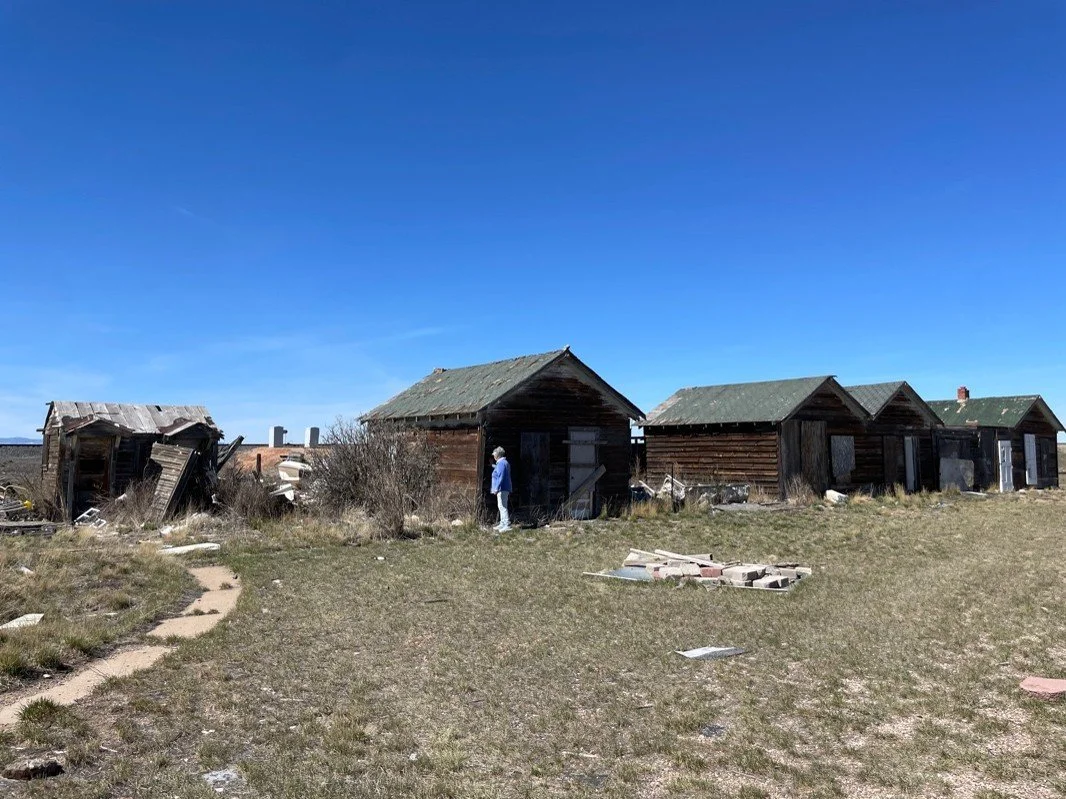
Caption: The author inspecting a cabin and it’s decaying outhouse on Highway 287, wondering what it was like to live for four years in one. These are at Bosler, 20 miles north of Laramie where Ruby and Elmo Hammond and two of their eventual four daughters lived from 1935–1939. The transients from Oklahoma were allowed to stay free in one of these cabins in return for Elmo’s work running the Texaco station in Bosler. They eventually got jobs at UW and bought a house in Laramie. Ruby expressed gratitude for being taken in by folks in Bosler when they were homeless and jobless.
Photo Credit: Christy Knight Spielman, April, 2026.